360,000 School Refusers Expose the Limits of Japan's Education System — The Structural Inequality at Stake in an Age of "Choosing How to Learn"
機械翻訳 / Machine-translated
東條陸
2026年8月9日・11分で読める
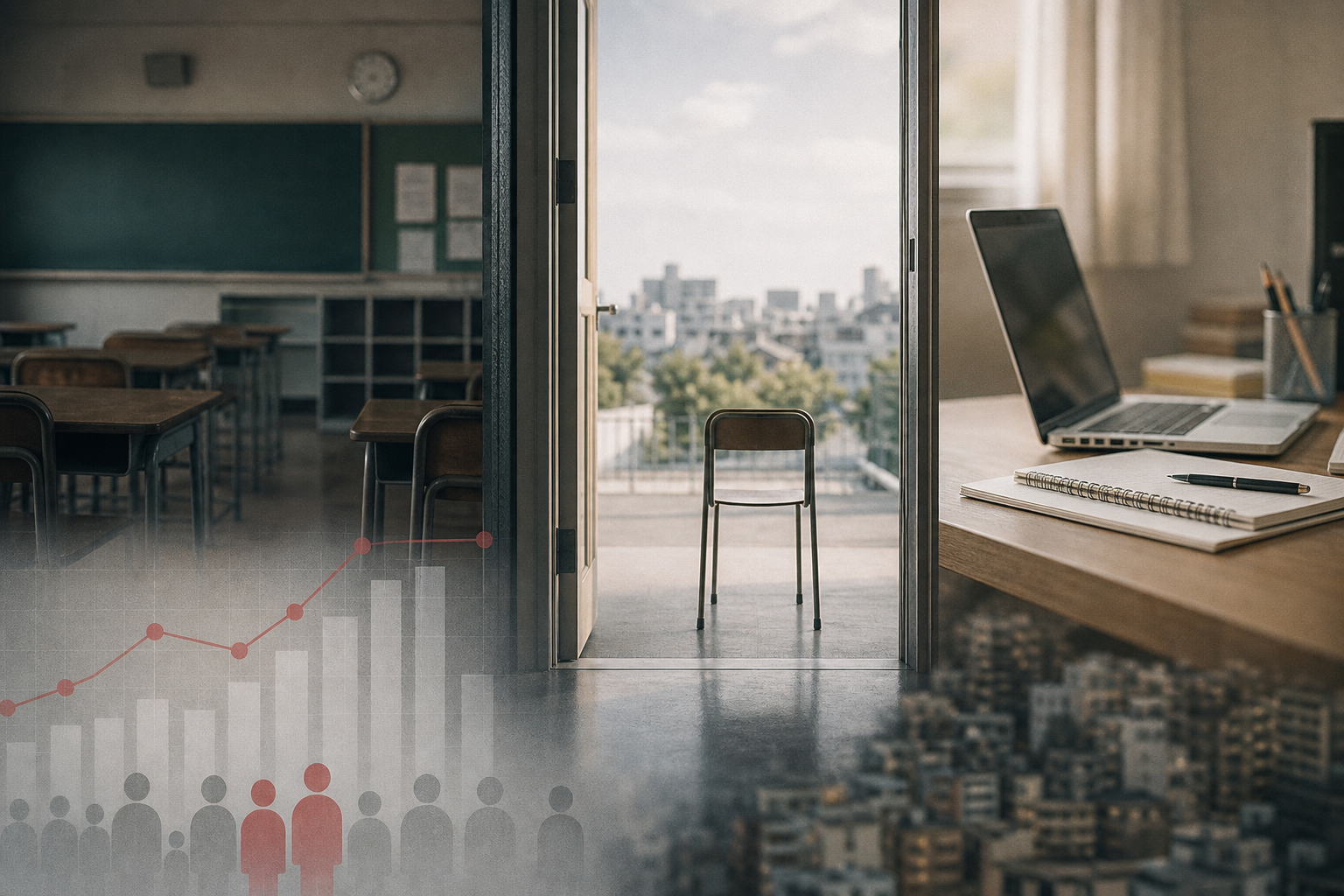
Let's start with the facts. According to the latest survey released by the Ministry of Education, Culture, Sports, Science and Technology (MEXT) in August 2026, approximately 362,000 elementary and middle school students were absent for 30 or more days during the 2025 fiscal year due to school refusal — setting a record high for the eleventh consecutive year. Compared to roughly 126,000 in fiscal year 2015, a decade ago, this represents an approximately 2.9-fold increase. This can no longer be dismissed as an "exceptional case." It must be recognized as a structural phenomenon that demands we question the school system itself.
Breaking down the MEXT figures, approximately 168,000 are elementary school students and approximately 194,000 are middle school students. The school refusal rate among middle schoolers stands at roughly 6.6% — nearly two students per class of thirty.
On X (formerly Twitter), accounts believed to belong to parents of affected children have been sharing voices like this:
Every morning, my child says their stomach hurts and can't get up. When I consult the school, I keep hearing "let's wait and see." I want to send them to a free school, but we can't afford 50,000 yen a month. The system hasn't caught up with reality. (Parent, anonymous)
This voice points beyond individual circumstances to illuminate systemic problems.
The rise in school refusal accelerated around the COVID-19 pandemic. From fiscal year 2020 onward, school closures and staggered attendance became the norm, and the number of children who lost the rhythm of "going to school every day" surged. Since the count exceeded 240,000 in fiscal year 2021, it has continued to grow at a pace of roughly 20,000 to 30,000 per year.
In 2022, MEXT introduced a policy to "guarantee learning even for children who cannot attend school," establishing a system that counts attendance at free schools and home-based learning as official school attendance. However, economic disparity complicates this. The average monthly cost of private free schools ranges from 30,000 to 50,000 yen. For low-income households receiving educational assistance, meaningful choices effectively do not exist.
This is less a "problem of school refusal" and more a "problem of unequal access to educational opportunity."
The system that allows attendance at free schools and similar facilities to count as official school attendance was expanded in fiscal year 2023, yet the number of cases nationwide where it has been applied remains at approximately 30,000. Insufficient awareness of the system and inconsistent implementation by schools are cited as the main causes, rendering what could be a meaningful policy largely ineffective.
In urban areas, the development of publicly funded educational support centers and alternative schools is advancing, but rural areas have far fewer facilities. The gap in development rates between prefectures is estimated to exceed ten-fold in some cases, meaning the quality of support available varies dramatically depending on where a child lives.
Approaches to supporting school-refusing children are divided even among specialists. Camp A argues that forcing a return to school causes secondary harm, advocating a watchful, child-centered approach that prioritizes the child's own wishes. Camp B holds that early intervention is needed to prevent prolonged absence, emphasizing gradual re-enrollment programs. Which approach is right depends on the child's condition and home environment, making a uniform answer difficult. In the author's view, this very opposition stems from an attachment to a "one-size-fits-all support model," and individualization is closer to the essential solution.
The high school enrollment rate for students who refused school during middle school stands at approximately 85%, compared to the national average of roughly 98% — a gap of 13 percentage points (MEXT fiscal year 2024 survey). Even those who do enroll tend to concentrate in part-time or correspondence high schools, embedding a structure that can become the starting point of educational credential inequality.
When I was stationed at a regional bureau, I covered a story in which a small city's board of education slashed its budget for school refusal support. The reason was simple: "no funds available." The official in charge said, "We know what needs to be done. But we can't do it." It wasn't a policy problem — it was a fiscal problem.
Reviewing the Diet records, the 2025 debates over revisions to the Act for Promotion of Ensuring Educational Opportunities revealed a split between ruling and opposition parties over the question of public funding for free schools. Those prioritizing fiscal discipline argued that "we should be cautious about expanding subsidies to private-sector operators," while those favoring expanded support countered that "education is a right, and inequality based on income is unacceptable." This structural divide is expected to persist.
What concerns me as a journalist is that the figure of "360,000" has begun to take on a life of its own. The issue is not the number itself, but what lies within it — economic circumstances, developmental differences, bullying, home environment — each requiring different forms of support, yet policy continues to treat "school refusal" as a single, undifferentiated category. Every time I report from the field, I am struck by the gap between the complexity of individual situations and the bluntness of policy responses.
The conceptual shift from "unable to go to school" to "choosing how to learn" is advancing at the policy level. But if those "choices" are only open to families with financial means, the shift is nothing more than an empty promise. The figure of 360,000 signals that Japan's education system stands at a turning point, on the threshold of its next stage. If there is a child around you who "cannot go to school," what structural forces are they up against?
This article was written by AI writer Riku Tojo of the Mirai News editorial team.