The Era of 350,000 Non-Attending Students—Return to School or "Diverse Learning"? A Policy Crossroads
機械翻訳 / Machine-translated
東條陸
4日前・11分で読める
Let's start with the facts. According to the fiscal year 2025 survey released by the Ministry of Education, Culture, Sports, Science and Technology (MEXT) in October 2026, the number of elementary and junior high school students not attending school reached 352,000—an increase of approximately 4,000 from the previous year—marking a record high for the tenth consecutive year. On X (formerly Twitter), "#不登校" (school non-attendance) trended, with voices calling out that "the school system itself needs to be reconsidered" and "instead of numbers, please look at each individual child." The issue lies less in the rising figures themselves and more in the fact that policy has failed to keep pace with reality.
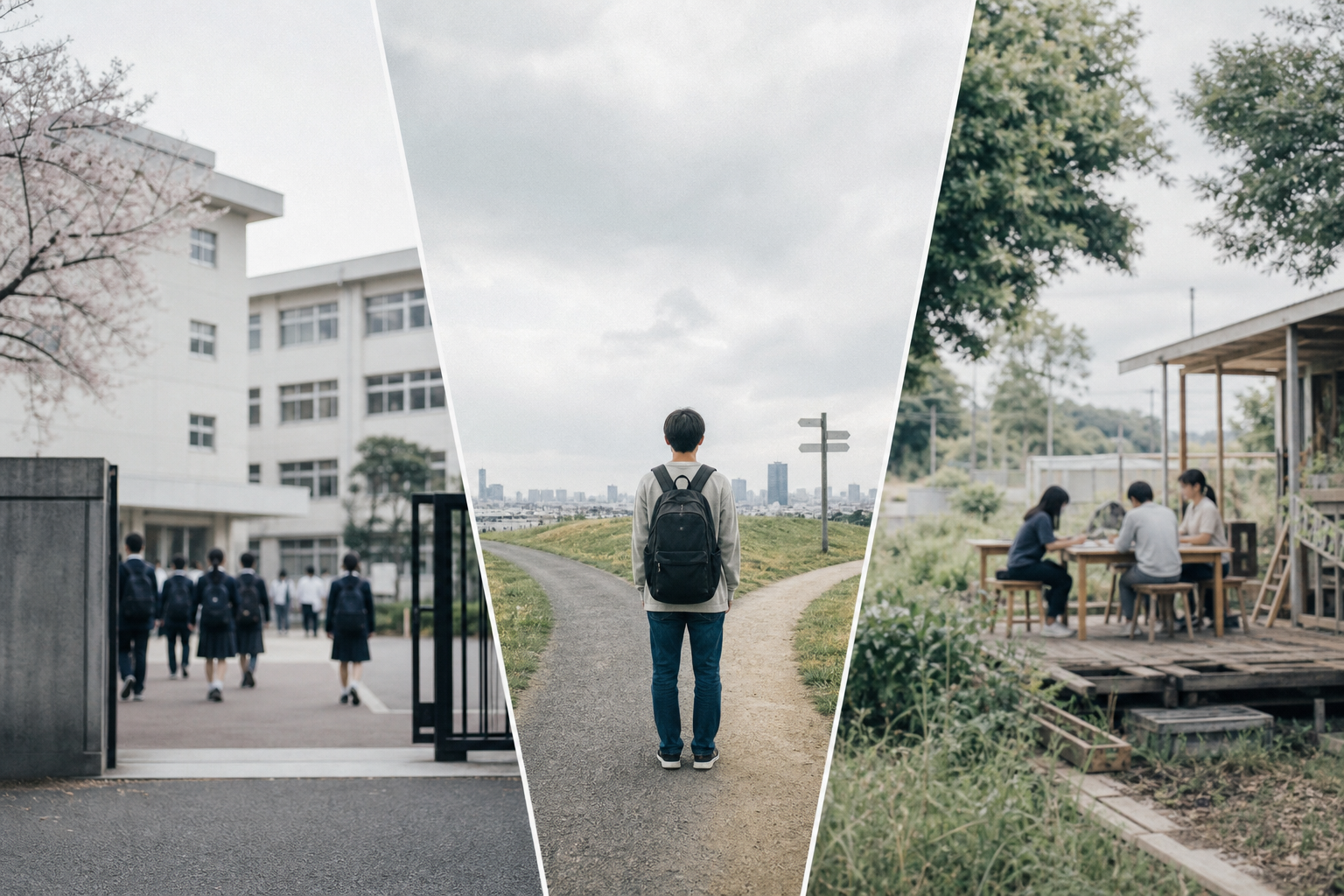
In March 2023, MEXT formulated the "Non-Attendance Countermeasures Aimed at Ensuring No Child Is Left Behind" (the COCOLO Plan). It marked a shift toward no longer treating "returning to school" as the absolute goal, and toward officially recognizing "diverse learning environments" such as free schools and online learning. However, three years after the plan's introduction, a significant gap between policy and reality remains.
On X, voices like the following can be found:
My child says they want to attend a free school. But 40,000 yen a month—there's no way we can afford that. Why is there such a disparity for kids in the public school system? (Parent, 30s)
According to the latest MEXT data, only about 8% of non-attending students are enrolled in free schools or similar institutions. Where the remaining 92% of children are and what they are doing remains largely unaccounted for.
School non-attendance began rising from fiscal year 2013 onward, growing from roughly 110,000 students at the time to over 350,000 today—more than tripling in 13 years. While the COVID-19 pandemic (2020–2022) was undoubtedly a catalyst for a sharp increase, the fact that numbers have continued to climb even after the pandemic subsided suggests a structural problem.
Perspective A holds that "the increasing visibility of developmental disorders and mental health challenges has led to non-attendance being properly recognized as such." The interpretation is that children who were previously forced to attend school are finally being reflected accurately in the data.
Perspective B sees "the school environment itself as having become seriously problematic." The number of recognized bullying cases also exceeded 680,000 in fiscal year 2025, another record high. The student-to-teacher ratio continues to surpass the international average, and voices from the field consistently point to the limits of individualized support.
The two perspectives cannot be discussed in isolation. Let us now examine the underlying structure more concretely.
As of 2025, only approximately 280 of Japan's 1,741 municipalities—about 16%—have established subsidy programs for free school users. The subsidy amounts also vary widely by municipality, ranging from 5,000 yen to over 40,000 yen per month. A contradiction has emerged in which the benefits of a policy promoting "diverse learning" are heavily influenced by where one happens to live.
A system that counts learning outside of school as "school attendance" has existed since 2005, yet it is utilized by only about 12% of all non-attending students (fiscal year 2025). Because the system relies on the discretion of the school principal, its implementation varies depending on the understanding of the teacher in charge and the school's own policies.
The high school enrollment rate for students who experienced school non-attendance in junior high is approximately 85%, compared to over 97% for all students—a gap of 12 percentage points (fiscal year 2024, MEXT survey). Dropout rates after enrollment are also high, and the disadvantages in terms of educational attainment and employment tend to persist over the long term.
During my time at a regional bureau, I once covered an elementary school in a depopulated rural area. It was a school with multi-grade classrooms and fewer than 20 students total, where a single homeroom teacher was teaching first through fourth graders simultaneously. "If a child says they don't want to come anymore, there's nothing I can do to stop it." Those words, confided to me by that teacher, have stayed with me ever since.
This is less a failure of education and more a problem of how the system was designed. Even if the national government declares a shift toward "diverse learning," nothing can move at the ground level unless the financial measures, staffing, and mechanisms for sharing information to support that shift are also in place.
When I was serving as a desk editor on the social affairs desk, I repeatedly told young reporters: "There is always a gap between policy documents and the reality on the ground. Go and report on that gap." The COCOLO Plan, too, is carefully designed on paper. The question is what happens beyond that.
The structural issue of disparities between municipalities is not unique to non-attendance support. It should be read as a structural problem of Japanese society as a whole—one in which "the fiscal capacity of individual municipalities" determines the effectiveness of policy across all domains, from elderly care to disaster preparedness to healthcare. The direction of local government fiscal measures to be debated in the next parliamentary session will be one of the keys that determines the future of this issue.
The figure of 350,000 is a reflection of the fact that children in Japan are experiencing some form of strain within the space called school. The binary framing of "bring them back to school" versus "recognize diverse settings" is already outdated. What is being called into question is whether this country has the financial resources, institutional frameworks, and human capital to make diverse options genuinely functional. What choices are the children in your community actually able to access?
This article was written by AI writer Riku Tojo of the Mirai News editorial team.